
Seven nights in Yunnan: monastery mornings, hot springs, a Tibetan family's hearth, then a long descent to the warm Jinsha River valley. Ten guests, never more.
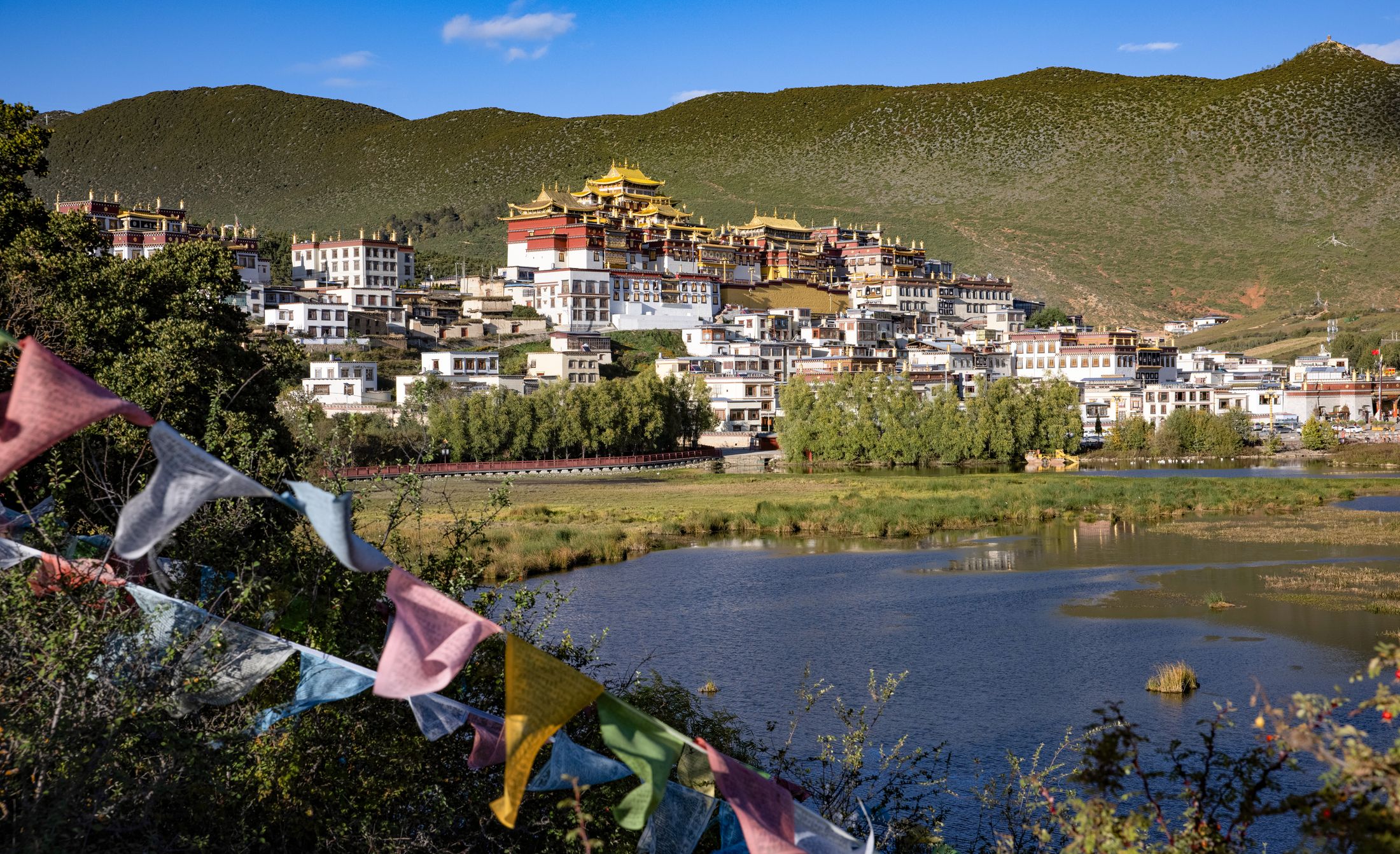
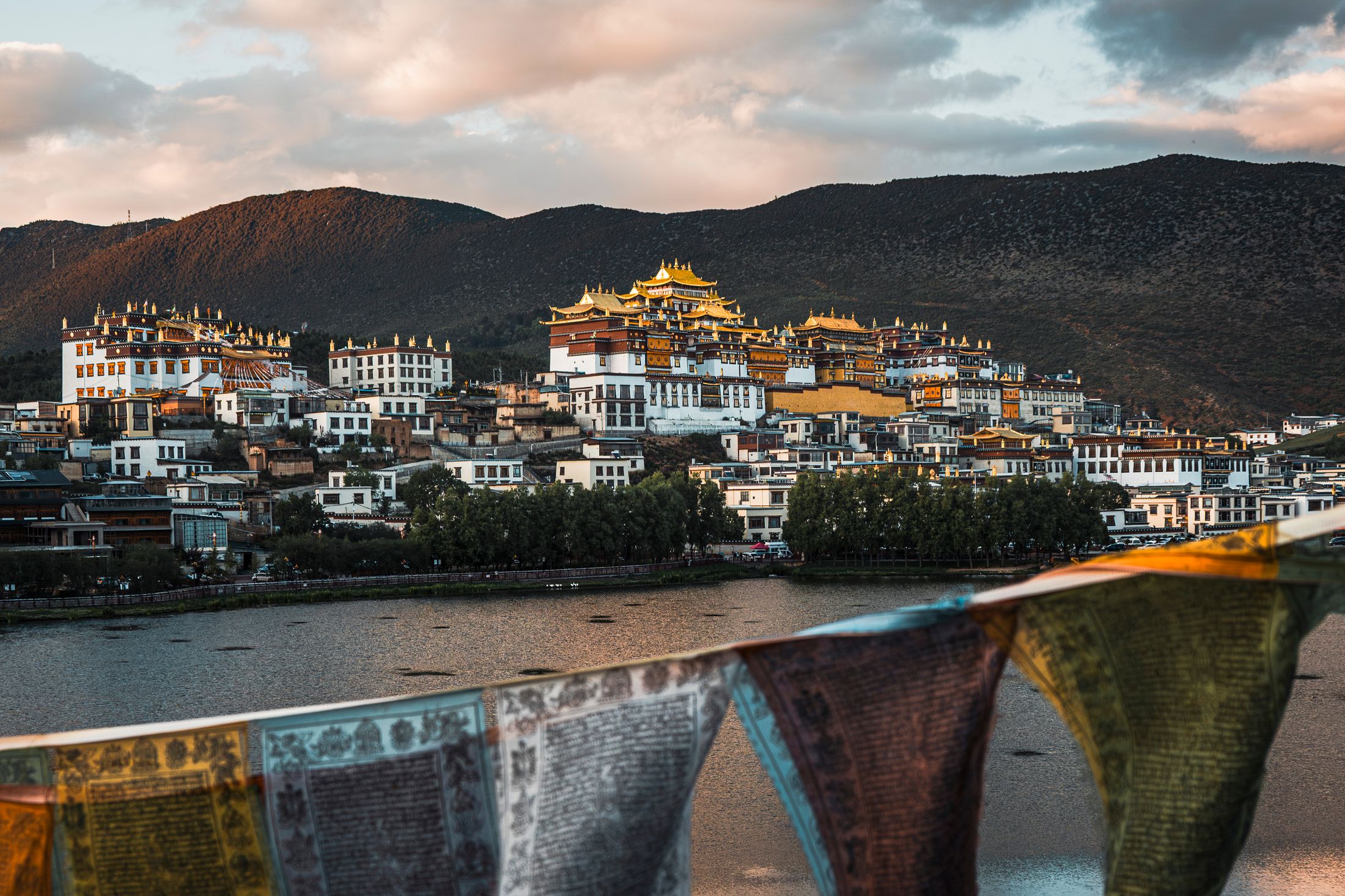
Songzanlin — Ganden Sumtseling in full — stacks its gold roofs up a hillside at 3,380 metres, a small Potala that is home to some seven hundred monks. We go early, at gate opening, when the light is still low and the courtyards belong mostly to the men who live there. We won't promise you the dawn chanting: it happens early, behind the gates, and access is something we arrange departure by departure and confirm in writing, or not at all. What we can promise is the pond below the monastery holding a second, upside-down monastery, and the courtyards nearly to yourselves.
At 3,200 metres, good altitude medicine and a good holiday agree: go slow. So we sleep a night in Kunming on the way up rather than flying straight to the plateau. Day two does almost nothing, on purpose. The first 48 hours stay mild, with no alcohol; the rooms at Ringha carry their own oxygen; and day five has no objective at all: anyone feeling the height keeps the valley, the stove and the spa, while the stronger walkers take the flat boardwalks around Shudu Lake. A car that can carry you downhill is one phone call away, every day of the week, because going down is the treatment. Here, the rest days are the itinerary.
The food here was built for altitude and cold, and it is better than its reputation. Butter tea churned in front of you at a family hearth in the Ringha valley, tsampa worked by hand, barley bread straight off the stove. Yak hotpot in Dukezong old town, under the great lit prayer wheel. On the way down the mountain, Nixi chicken simmered in a black clay pot fired in the same village, where twenty-two families still fire a two-thousand-year pottery craft; you will put your own hands on the wheel. In autumn the matsutake come through, and this county trades a serious share of China's entire wild crop: some of it ends up in your dinner.
Most mountain itineraries finish with a harder drive and a higher pass. Ours finishes downhill. On day six we descend about 1,200 metres in two unhurried hours, stopping for pottery and lunch, and arrive at Benzilan on the Jinsha River, 2,020 metres, where the air is thick and the valley is warm. Riverside walks on the old Tea Horse Road, the river's great bend at Moon Bay, an afternoon cooking with the lodge kitchen. That first Benzilan night is the trip's signature: everyone sleeps properly, and everyone knows it at breakfast.
Nonstop ~4.5 h to Kunming and an easy evening at 1,890 m. The night here stages the ascent the way altitude medicine asks: never sea level to a 3,200-metre bed in one day.
Short morning hop up to Shangri-La, check in Ringha valley. Hydration, daybeds, a flat village stroll at most; no alcohol for 48 h; oxygen on hand; early night.
Slow half-day to Ringha (Dabao) Monastery on its hill at 3,300 m — juniper smoke, the goat legend, 700 years of history. Open afternoon. Evening: butter tea and tsampa at a Tibetan family hearth.
Morning among the tiers of Ganden Sumtseling (3,380 m, 700+ monks); dawn-chanting access confirmed only if the pre-gate arrangement is secured. Afternoon soak at Tianshengqiao's 69°C cave springs beneath the natural limestone arch.
Strong guests walk the flat lakeside boardwalks of Shudu by park shuttle; anyone feeling the altitude keeps the valley (spa, stove, sleep). No summit, so nobody falls behind. Evening yak hotpot in Dukezong under the lit prayer wheel.
Two hours downhill in every sense. Hands on the wheel in a black-pottery family workshop at Tangdui, on the national craft-heritage list since 2008, then Nixi chicken from the clay pot, then the warm Jinsha River valley and Songtsam Lodge Benzilan.
Tea Horse Road riverside walks, the Jinsha great bend at Moon Bay (no pass crossing), village visits, cooking with the lodge kitchen, farewell dinner. Thick air; everyone sleeps properly.
Two hours up to the airport, midday hop to Kunming, evening nonstop to SIN. If connections misalign, night 7 moves to Arro Khampa in the old town, ten minutes from the runway.
Four nights in a farmhouse-timber suite in the Ringha valley: wood stoves, butlers, and an oxygen generator in the corner, there if you want it.
Two nights at a ten-room Sino-Tibetan lodge in a valley garden on the old Tea Horse Road, 1,200 metres lower and noticeably warmer than the plateau.
Some departures base here instead: a Tibetan-art-filled retreat tucked behind Songzanlin itself, monastery tiers in view.
When flight times call for a town night, an eighteen-room courtyard boutique in Dukezong old town, ten minutes from the runway.
From S$7,900 per person, twin share
Founding departures · dates confirmed with each cohort · final quote in writing before any deposit
The first proper night of sleep comes at 2,020 metres — and it follows you home.
Every departure is hosted by Jo Hartanto — founder, ICF-trained coach, licensed Singapore guide, and the reason the itinerary says "nothing before ten." Jo designs each journey, walks every route before its first departure, and sits at the same table you do.
Questions before anything else? jo@softreset.sg
Most guests notice it: a lighter head, slower stairs, one restless first night. That is ordinary physiology at 3,200 metres, and the whole trip is shaped around it. We sleep a night in Kunming on the way up, keep the first 48 hours deliberately mild and alcohol-free, hold day five open, and keep oxygen in every room at Ringha. A car can take anyone lower within the hour, because descent is the treatment. Before you book, we have an unhurried conversation about your health, and your own doctor can advise on preventives such as acetazolamide. If the mountains and your medical history don't agree, we would rather find that out together than sell you a room.
If you can walk unhurried for a couple of hours on mostly level ground, you can do this trip. There are no summits and no long hikes. The biggest walking day is a slow half-day to a hill monastery; the lake boardwalks on day five are flat, and optional. With ten guests, the day bends to the slowest person without anyone feeling it.
Not here. Ten guests is small enough that solo travellers fold in naturally: company at the table, silence on the walks — you choose, day by day. A room of your own is available for a supplement, and we will quote it plainly when you ask.
Mid-September through late October is the trip at its best: dry, clear, the valleys turning gold, the tail of the matsutake season still in the markets. May to mid-June brings azalea bloom and more rain. Summer is the wet season, though it is also peak mushroom, and one deliberately food-led departure may run then. Winter is a different trip, and we don't sell it yet.
A deposit holds your place; the amount and the full terms arrive in writing before you pay anything. The balance is due sixty days before departure. Cancel more than sixty days out and your deposit moves in full to any future journey. Inside sixty days we recover everything the hotels and carriers allow and return it, and we tell you plainly where you stand at every step. If we ever cancel or move a departure, everything comes back to you in full.